EMS Resources

Mar 28, 2018

How Acadis Meets Your Specific LMS Needs

If you have managed training, you know doing a good job goes well beyond the classroom. Recordkeeping matters, as do administrative functions like inventory, training staff logistics, and enrollment. While you may currently rely on a number of digital and manual systems to ensure your personnel receive the best possible education—and though reliance on “legacy” systems may make you reluctant to pursue an upgrade to your current processes—Acadis represents a better approach: a single platform that considers every aspect of training and groups it into an efficient, streamlined, and modular grouping of tools to help your training program thrive.

Read More

Feb 27, 2018

For First Responders, Avoiding Breaches Starts with People

Information security can be a high-tech affair, but staying secure means promoting smarter human behavior—and enforcing policies that require it.

Read More
Jan 11, 2018

Cross Training: The Risks and Rewards of Consolidating First Responder Skills

As those who work within the fire, law enforcement, and EMS fields know, there is very little middle ground between those who favor cross training—often referred to as “consolidation,” or the act of training one professional group with some combination of the other two groups’ skills—and those who oppose it. This whitepaper provides an objective overview on the topic, including relevant facts, comparison of success and failures.

Read More
Dec 1, 2016

Incident commander: increase effectiveness and efficiency through combined response

For some first responders, readiness means that everyone has completed all applicable training and certifications. For others, readiness is a team that is fully equipped with the tools and resources needed to fulfill their duties. From initial response to large scale incident management, the estimable readiness of personnel and equipment is always at the forefront of the commander’s mind.

Read More
Oct 1, 2016

Fire TCP Panel Discussion

The Fire Training Certification Program (Fire TCP) launch occurred on September 30, 2016. The panel was moderated by John Buckman and the panelists included: Leigh Hubbard (Executive Director of ISFSI), Steve Pegram (President of ISFSI – Chief of Goshen, OH Fire Department), Ari Vidali (CEO Envisage Technologies), Eddie Buchanan (Assistant Chief of Hanover Fire & EMS – Advisory for Fire Engineering and FDIC), and John Murphy (Legal Advisory for ISFSI).

Read More
Sep 1, 2016

Cover Yourself: How to make training legally defensible

In this webinar, Gerry Roberts, JD defines legally defensible training and shares ideas for how to improve your training and record-keeping so that your records have the best chance of providing a solid defense in the event of litigation.

Read More
Aug 19, 2016

Easing the burden of turnover in the fire service

Given these shrinking resources, the cost of turnover in the fire service is a difficult challenge to overcome. Recent reports are drawing attention to the need for better understanding, planning, and budgeting for turnover before it wreaks havoc on department services.

Read More
Jun 29, 2016

Next Generation 911 lays a foundation for future changes

Imagine being able to communicate with emergency services from any connected device. This has long been the goal of the National Association of Emergency Numbers (NENA), as their slogan, “Anyone should be able to connect to 911 on any device, from anywhere, at any time,” reflects. This also encompasses the goal of equal accessibility to emergency services for those with difficulty communicating.

Read More
Dec 8, 2015

Text-to-911 technology offers a new way to reach help

Car accidents and fires are obvious situations that may require a call to 911. For the most part, doing so does not increase risk for the caller. However, in cases of domestic abuse or abduction, calling 911 can put the victim in grave danger. In these situations, new technology that allows people to silently text to 911 can be life-saving

Read More
Feb 20, 2014

Meet disasters with ‘end-to-end’ preparedness

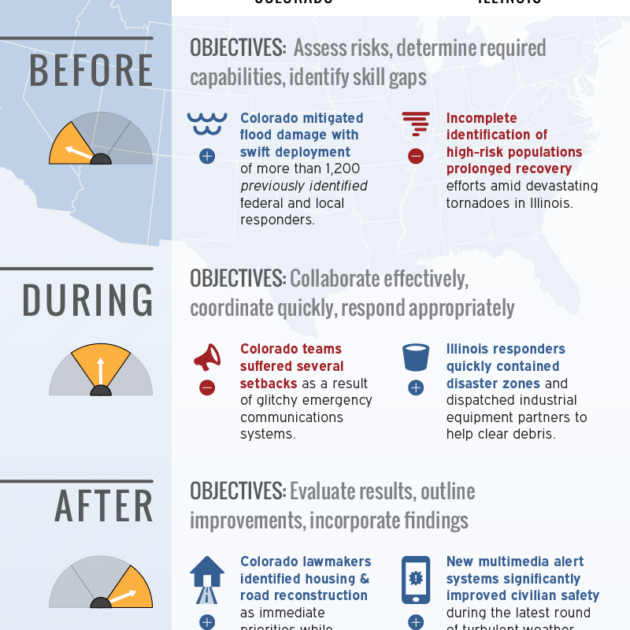
Disasters can strike anywhere and at any time. The process of planning for and evaluating these events, however, extends beyond the crisis in progress.

Read More